
Stress in Shelter Cats: Research-Based Tips on Cat Behavior Assessment & Welfare
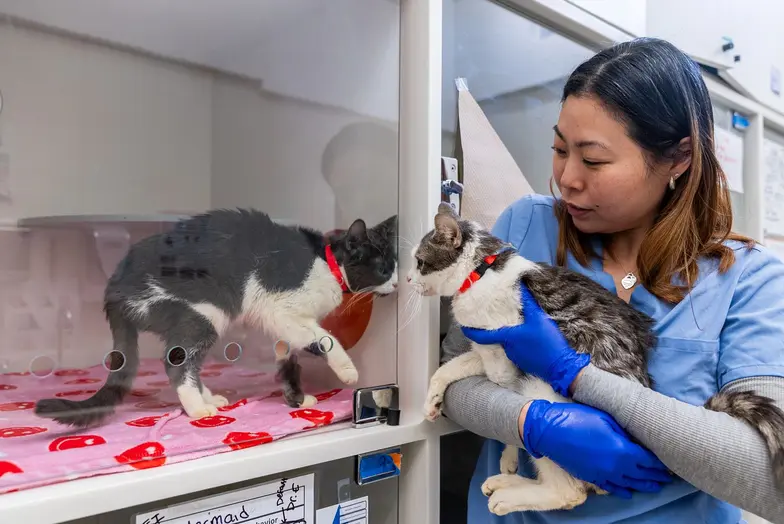
More cats (3 million) entered U.S. animal shelters in 2025. This number outpaces dogs (2.8 million) relinquished to U.S. shelters in 2025 (Shelter Animals Count, 2026). We need to turn our attention to sheltered cats to improve their welfare, provide quality care during their shelter journeys and to right-size our expectations for feline capacity for care. Having a validated, easy-to-use tool to monitor feline welfare is a must. There are very few feline behavior assessments that evaluate stress and welfare for sheltered cats, and even fewer that have been scientifically validated.
A common tool for identifying stress in cats, the Cat Stress Score (CSS), was developed in the 1990s by Kessler & Turner (1999a, 1999b). This tool was used in catteries and animal shelters (i.e., cats in captive environments) to identify stress levels by observing behavior. The Cat Stress Score uses a scale of 1 (“relaxed”) to 7 (“terrified”). Recently, the ASPCA developed a Psychological Quality of Life (PQoL) tool to monitor the welfare of sheltered animals (i.e., the balance of positive and negative experiences), including cats. An overall welfare rating from 1 (“extremely good”) to 7 (extremely poor”). The PQoL assesses cat behavior using 11 questions that cover behavior, attitude, and activity. Researchers compared results from both the CSS and PQoL in the same cat population at one animal shelter to evaluate the construct validity and reliability of the PQoL.
Study Design
A set of singly-housed, healthy adult cats was selected from one shelter for simultaneous observation by two observers. Each observer rated individual cats using both the CSS and PQoL twice on days 2, 4 and 6 of their shelter stay. This yielded 12 observations per cat, across 50 cats, for data analysis.
One caveat to consider is how the researchers applied the PQoL to the selected cats. Initially, the PQoL was developed to monitor the welfare of sheltered animals during stays longer than 6 days. Thus, it was intended to be a baseline measurement that was repeated by one or more consistent individuals regardless of the length of the animal’s length of stay in the shelter. Previously, a research summary takeaway was that any behavior or welfare assessment, once validated, should be used as designed and not changed to maintain its validity. Thus, there are differences between the PQoL use instructions and the use adaptation made here by researchers. They explain that their adaptation was made to make it easier for staff in a typical shelter to use the PQoL tool. This paper explores whether their adapted use of the PQoL is a valid and reliable method for assessing welfare in a specific subset of healthy adult cats living in standard kennels during the first 6 days of their shelter stay.
Study Results
Validation of the PQoL
When comparing the two 7-point scales (CSS and PQoL) for Observer A - who observed all 50 cats at all six time points – the CSS and overall PQoL were strongly correlated, which means the overall PQoL is a valid tool when compared with an accepted tool like the CSS (i.e., criterion validity). The CSS is also considered valid (i.e., concurrent validity) based on the comparison of the two tools. In other words, when comparing the two tools using a single person’s ratings, both work as intended.
Inter-rater & Intra-rater Reliability
Inter-rater reliability measures how well two or more people rate the same thing (e.g., feline behavior) using the same tool at the same time. It is asking how consistent the ratings are across multiple observers. Observer A (one person) and Observer B (three different people, one per cat) had moderate to substantial agreement on all six ratings for each cat. The PQoL was reliable across four different observers.
Intra-rater reliability measures whether one person can produce the same results when evaluating the same cat’s behavior two or more times, using the same tool. The overall PQoL for Observer 1 (who rated all 50 cats) had substantial to almost perfect agreement for all three days (i.e., six ratings)! The agreement between ratings improved each time Observer 1 completed the PQoL; ratings were more consistent as the observer gained more practice with the PQoL. For the CSS, intra-rater reliability was substantial to almost perfect for all 3 days. Thus, both the PQoL and CSS were reliable across multiple ratings.
Key Takeaways
Shelters can be confident in using the Cat Stress Score to monitor feline stress-related behaviors and the Psychological Quality of Life tool to monitor the welfare of sheltered cats. Both tools are valid and reliable, as used by this research team in singly-housed, healthy adult cats. It is a core responsibility of animal welfare organizations to evaluate and monitor the stress and welfare of their animal populations at the individual and species levels.
When choosing to use either tool, shelters should consider how they will use the information gathered and the impact on the care provided to sheltered cats. Is the cost of collecting this information worth the benefit? Will it reduce stress or improve welfare for our sheltered cats? Using the CSS is easier for users with limited knowledge of feline behavior, while users of the PQoL improved with practice and familiarity with the tool. This suggests that the training required to use each tool is likely to vary across users.
While scientifically validated for use in the first 6 days of a cat’s shelter stay, the PQoL still needs additional research to increase its validity and reliability across diverse cat populations, a range of shelter and housing types, and longer shelter stays, including both the intended use and the adapted use as described in this paper. The CSS has been used across many cat populations and in a variety of contexts, contributing to its status as a “gold standard” for evaluating observable stress-related behaviors in sheltered cats.
A newer Holistic Quality of Life (HQoL) has been developed by the ASPCA since this study was conducted. The more recent version adds health-related questions to the PQoL. So, the HQoL can be considered a partially validated tool, and more studies are needed to validate the HQoL overall welfare rating, inclusive of the health-related questions.
In short: the future of behavior assessments is feline!
We’d love to hear how you currently monitor the stress and welfare of cats in your shelters. Will you consider using either the CSS or QoL tools mentioned above? Feel free to email us at shelterbehavior@aspca.org!
Citations:
Kessler, M. R., & Turner, D. C. (1999). Effects of Density and Cage Size on Stress in Domestic Cats (Felis Silvestris Catus) Housed in Animal Shelters and Boarding Catteries. Animal Welfare, 8(3), 259-267.
Kessler, M. R., & Turner, D. C. (1999). Socialization and stress in cats (Felis Silvestris Catus) housed singly and in groups in animal shelters. Animal Welfare, 8(1), 15-26.