
Capacity for Care in Animal Shelters & Rescues
You don’t need to dust off your scientific calculator to understand your shelter’s capacity for humane care. While there are times when performing a few key capacity calculations for housing [PDF], staffing [PDF], and behavior [EXCEL] can be useful, shelters just need to ask themselves one question:
With the resources we have today, can we meet the physical and behavioral needs of every animal in our care?
If the answer is no, perhaps those resources can be created or obtained, or perhaps steps can be taken to move that animal to a partner that is better prepared to meet those needs. If this happens for a large number of animals or on a consistent basis, follow these steps for Conquering Crowding [PDF] and shift operations back within your shelter’s capacity.
A shelter’s capacity for humane care cannot be defined by a static number of animals or a line item in a budget. It is constantly changing and is influenced by many factors including:
- Number of humane physical housing units
- Number of animal care personnel
- Knowledge, training, and skill level of animal care personnel
- Number of animals currently in care
- Additional needs of animal currently in care (e.g., specific medical or behavioral care)
- Financial resources
- Animal length of stay
- And many more
Length of Stay
A common misconception is that housing more animals will lead to increases in the number of lives saved. Understanding the impact of length of stay on our ability to meet animals’ needs can help set the record straight.
Length of stay refers to the duration of time an animal spends in the shelter system from the day of intake to the day of outcome. Here’s an insider’s secret: Minimizing length of stay is the key to reducing crowding and increasing lifesaving capacity! That’s right: getting animals out of the shelter as quickly as possible is not only best for their physical and mental well-being, but it also allows you to serve a greater number of animals over time.
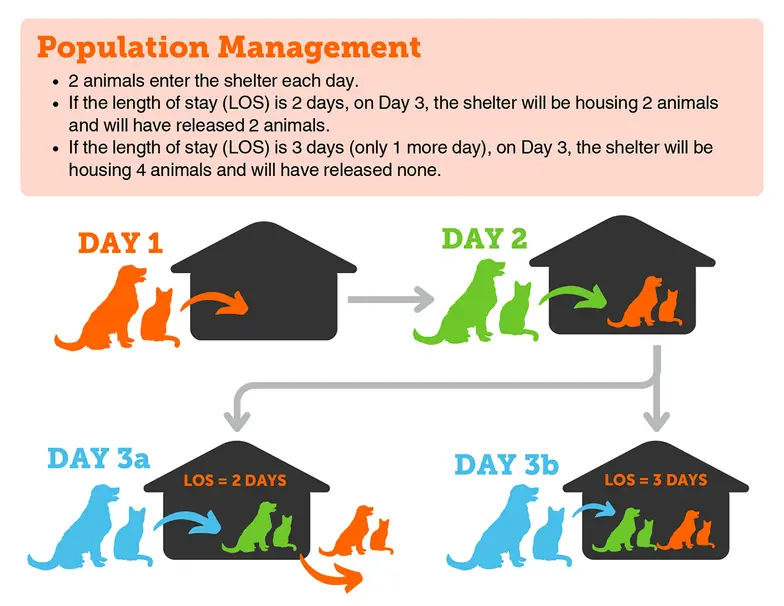
Check out the Length of Stay Game to learn more about how this works.
6 Tools to Conquer Crowding in Animal Shelters
Crowding is a serious concern in animal shelters and should not be taken lightly. It is a direct cause of compromised physical and behavioral health and welfare in shelter animals. Embracing these 6 tools can help any organization stay within its capacity and increase opportunities for positive outcomes!
-
Identify a population manager. This person is the key to maintaining the population within the shelter’s capacity for humane care. They are responsible for tracking daily population numbers, tracking length of stay by species and age, ensuring prompt evaluation and movement of animals to the appropriate location, planning co-housing of compatible animals (if necessary), investigating increases in daily population, and participating in daily rounds.
-
Perform shelter population rounds. The rounds team physically evaluates each shelter animal daily, asking (and answering): Who are you? How are you? Are you where you should be? Do you need something today? Do you need something to be scheduled? The team should include representatives from operations, medical, and behavioral care teams, along with the population manager. Personnel from adoption or animal placement teams and an executive management team member should also be periodically included.
-
Embrace fast-track adoptions. Identify animals likely to be adopted very quickly (i.e., puppies, kittens, small breed dogs, etc.) at intake and move them to the front of the line for spay-neuter, behavior evaluations, etc., to ensure they get out as quickly as possible.
-
Ensure timely transfer to placement partners. Know your transfer organizations and foster homes and what they are good at. Identify animals who are good candidates for transfer or foster care and get them there as soon as possible – ideally, before they ever enter the shelter. (Check out the Field to Foster training & resources.) Registering rescue partners as foster groups may help make this a smooth process.
-
Institute a policy of “open selection.” Allow all animals in the shelter, even those in their legal stray holding period, to be seen by the public and pet placement partners. Interested parties can indicate which animal they want, and they can be prepared to leave as soon as their holding period is over. First-come, first-serve – don’t hold out for a “better” option that may never come.
-
Divert intake whenever possible. Many programs can support people and animals without the animals coming to the shelter. Some examples shelters have found successful include: institute a spay-neuter and return to owner program, develop a behavior counseling service, encourage owner rehoming of unwanted pets, limit owner relinquishment to times when space is readily available, schedule owner relinquishments, encourage caregivers to keep litters until they are 8 weeks old, institute robust community cat programs, etc. The possibilities are endless.
Resources & Downloads
- Determining Housing Capacity [PDF]
- Determining Staffing Capacity [PDF]
- Determining Behavior Capacity [EXCEL]
- Conquering Crowding [PDF]
- ASV Guidelines for Standards of Care in Animal Shelters (Population Management section)
- Shelter Behavior Roundtable: Embracing Behavior in Capacity for Care Planning
Last Reviewed September 2026