Managing and Training Leash-Reactive Dogs
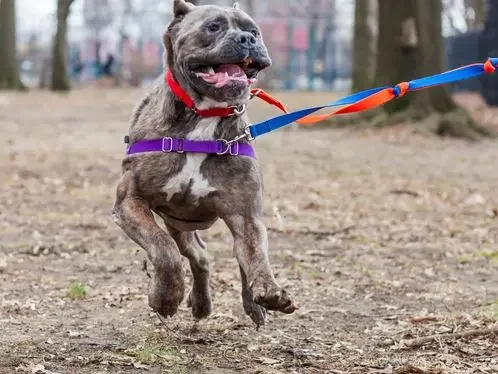
Walks should be enjoyable for both the dogs and the humans who walk them. When a dog is leash reactive and barks or lunges at other passing dogs, people, animals, or objects, walks become stressful. A leash-reactive dog may even have a harder time getting adopted and staying in their adoptive home.
Share these tips with dog adopters, volunteers and foster caregivers in your community to teach them:
- What leash reactivity is and what behaviors are associated with it
- Why some dogs are leash reactive
- How to manage leash-reactive dogs, including the use of helpful walking equipment
- How to teach dogs to be less leash reactive
Dogs Who Are Reactive On Leash
Some dogs lunge and bark at other dogs when on leash, a behavior that trainers call “leash reactivity.” There are a number of reasons why dogs develop this problem. Some fear or dislike other dogs because of a bad experience or because they weren’t well socialized to other dogs during puppyhood. For these dogs, barking and lunging on leash serves a purpose—it keeps approaching dogs away. Other leash-reactive dogs actually like members of their own species a great deal. In fact, they enjoy playing and greeting so much that they become intensely frustrated when they’re restrained.
Living with a leash-reactive dog can be quite embarrassing, especially if you live in the city and can only exercise your dog by taking them on leashed walks. Some dogs only react poorly to other dogs when they’re on leash. To avoid embarrassment and frustration, you may take your dog on shorter walks, perhaps at times when you know other dogs won’t be around. Unfortunately, a lack of exercise and exposure to other dogs can fuel their agitation, making them more anxious and even less sociable.
Why Dogs Are Reactive On Leash
Watching how dogs greet each other when off leash may help you understand why it’s so much harder for them to interact normally on leash. Unrestrained, socially skilled dogs usually approach each other in an arc, coming together gradually, wagging, soft-eyed, and displaying other signs of friendly interest. They circle and sniff each other’s faces and then hindquarters before deciding whether to move on or play together. A dog who forgoes this greeting ritual and instead barges straight up to other dogs is the one who tends to get into arguments or fights.
Contrast this scenario with two dogs meeting on a sidewalk. These dogs are forced to approach head-on, so they’re more likely to make direct eye contact with each other. This is a very threatening gesture in dog body language. Both dogs are also likely to be pulling hard toward one another, so the leashes are tight. The strangling sensation on their neck adds to the dogs’ tension. As the people walking the dogs become more apprehensive, they may start jerking the leashes and muttering things like “Be NICE!” This likely confirms to the dogs that a threatening situation is at hand. Is it any wonder that there’s often an explosion when these two frustrated dogs finally meet?
Managing the Leash-Reactive Dog
Avoiding situations that might upset or excite your dog is a perfectly reasonable way to cope with leash reactivity, especially if you live in a suburban or rural area where you don’t have to encounter other dogs very often. Here are some tips to help prevent the rehearsal of unwanted behavior:
- Walk at off-peak hours to avoid other dogs or drive your dog to a quieter location for walks.
- If you have a small dog who doesn’t mind being picked up, lift them up and toss a light jacket or towel over their face so they can’t see approaching dogs.
- If you have a larger dog, move between parked cars, cross the road, or even do a U-turn to get out of the way when another dog approaches.
- Try products that will somewhat obscure your dog’s vision, such as the ThunderCap®, available at https://thundershirt.com/products/thundercap-for-dogs , and Doggles® sunglasses, available at www.doggles.com. By making it harder to see other dogs clearly, these products may significantly reduce a reactive dog’s responses. During car rides, your dog can also wear these products or ride in a covered crate to prevent reactions to things they might see through the windows.
- A head halter, such as the Gentle Leader® Headcollar or the Halti® Headcollar, can be very helpful for managing leash-reactive dogs.
Training the Leash-Reactive Dog
Although it’s fine to stick with simply managing your dog’s reactive behavior, you can make their life less stressful by working on changing how they feel when they see other dogs during walks. The following exercises are designed specifically for fearful dogs whose reactivity stems from a desire for more space. By showing them that good things consistently happen whenever they see other dogs, you’ll be creating a more positive emotional response.
Other Dogs Make Great Things Happen
Desensitization and counterconditioning involve repeatedly pairing a small amount of something your dog doesn’t like with a much larger amount of something they love. With time and repetition, your dog will react with happy anticipation when they see the thing that used to upset them.
Before you get started, recruit a friend with a neutral dog who can help you with the first few training sessions. You’ll also need to cut some tasty treats into pea-sized pieces. Use something really exciting that your dog doesn’t usually get, like bits of cheese, chicken, hot dog or liver.
- In advance, determine your dog’s threshold—the distance at which they first start to notice other dogs but don’t yet growl, bark or lunge at them. If your dog’s threshold is 40 feet, start with your friend and their dog at about 50 feet away.
- Pay attention to your own behavior, doing your best to be a calm role model by breathing deeply, using a calm voice and body language and keeping the leash relaxed.
- Have the helper dog appear for a few moments, coming into view from behind a gate, hedge, or parked car, or from around a corner. As soon as your dog notices the other dog but before they have a chance to overreact, start feeding them treat after treat smoothly and quickly, 10 to 15 in a row, praising calmly. After about five seconds, your helper should lead their dog out of sight again. As soon as the helper dog disappears, stop the treats and praise.
If a mistake happens and you realize the dogs are too close, use treats to lure your dog away, quickly adding distance. Some dogs will be happily distracted if you toss a bunch of treats onto the ground to encourage movement away, while also engaging their nose as they search for the tossed treats.
-
Have your friend lead the helper dog into and out of sight over and over, waiting a few minutes between sightings. Eventually, your dog will start to realize that the appearance of the other dog makes the treats and praise flow, and the dog’s disappearance stops their delivery. You’ll know that you’re making progress when your dog sees the helper dog appear and then immediately looks to you, wagging in cheerful anticipation of their treats.
NOTE: Pay attention to your dog’s body language. The goal is to keep them in a relaxed state rather than on the edge of an explosion, one that is only being blocked due to the delicious and distracting food you’re offering. Also, pay attention to the way the dog is taking the food. If they’re snatching it or you feel the sharp pinch of teeth bearing down on your fingers when you offer the food, that indicates their arousal level is too high and you should create more distance between the dogs.
- The next step is to gradually move the helper dog closer to yours. When that is going well, you can begin to walk your dog around, too, slowly decreasing the distance between the two dogs until they’re able to pass on the sidewalk. If your dog is extremely reactive, you’ll progress only a few steps at a time.
Some dogs who love food and become only mildly reactive around other dogs may develop a happy response to them in just a few sessions. However, most dogs need many training sessions over days or weeks to achieve permanent behavior change, so be patient. As you do the exercises above, it’s best to progress more gradually than you think you should. There’s no disadvantage to overtraining your dog’s happy response to another dog—but you do risk setbacks every time you push your dog too far and they react aggressively. The trick is to expose your dog to just a little of something not-so-nice (seeing another dog) and then give them a lot of something they really love. If you don’t have a friend with a helper dog, you can do the exercises above by taking your dog to a popular dog-walking path for training. (Just be sure to choose a place where you know other dogs will be on leash and unable to run up to your dog.) Remember to stand as far away from the path as necessary to keep your dog from reacting to other dogs. Over a period of days or weeks, you can gradually move closer until your dog is able to walk right past other dogs on the path.
A Head Halter Can Help
If your dog is extremely reactive or highly frustrated because they’re not able to approach or greet another dog, no matter the distance, a head halter can be helpful. It provides effective control and allows you to deliver a consequence when your dog lunges and barks.
First, you’ll need to accustom your dog to wearing a head halter. Spending the time to get your dog comfortable wearing one is very important.
A head halter looks a lot like a horse’s halter, and it gives you the same kind of “power steering” of their nose and head. This feature can greatly reduce pulling and lunging. Additionally:
- You can easily break your dog’s gaze if he’s staring intensely at another dog and then move them away to add more distance.
- If you gently and steadily pull straight up on the leash while your dog is wearing a head halter (causing their nose to point upward), you’ll be able to temporarily close their mouth and prevent them from biting another dog or redirecting their aggression toward you.
- Head halters aren’t muzzles. It won’t keep your dog’s mouth closed or prevent them from biting unless you pull up on the leash. However, a halter does look somewhat like a muzzle, so it may deter people from allowing their dogs to run up to yours.
- Head halters are purely a management tool. If you don’t want to use one long term, and after your dog has learned to behave calmly when seeing other dogs while wearing one, you’ll need to continue this work once you switch to other equipment, like a harness or collar.
Additional Recommendations
Even after you’ve completed your training and can walk past other dogs without incident, it’s still a good idea to carry treats for occasional rewards, especially if another dog is vocalizing or lunging.
- Some dogs are reactive on leash when they see humans or other animals, like cats or squirrels, or when seeing certain objects, especially those in motion, like rolling garbage bins or vehicles, and the techniques will work in these scenarios as well.
- Learn more about Canine Body Language for information about how your dog communicates. Learning what dogs look like when they’re feeling upset, aggressive or afraid can help you avoid potentially stressful situations. It also allows you to make adjustments in your training session (like adding more distance) to set your dog up for success.
- If you’ve tried all the recommendations above but your dog is still reactive on leash, contact a professional for guidance. A qualified animal behavior expert may be able to offer additional treatment strategies. It’s also important to seek professional help if your dog has bitten a person or another animal. To learn more about selecting a behavior profession, check out Behavioral Help for Your Pet.
We have lots more on this subject: