
Animal Shelter Resilience After Disaster: Brother Wolf Animal Rescue Charts a New Path
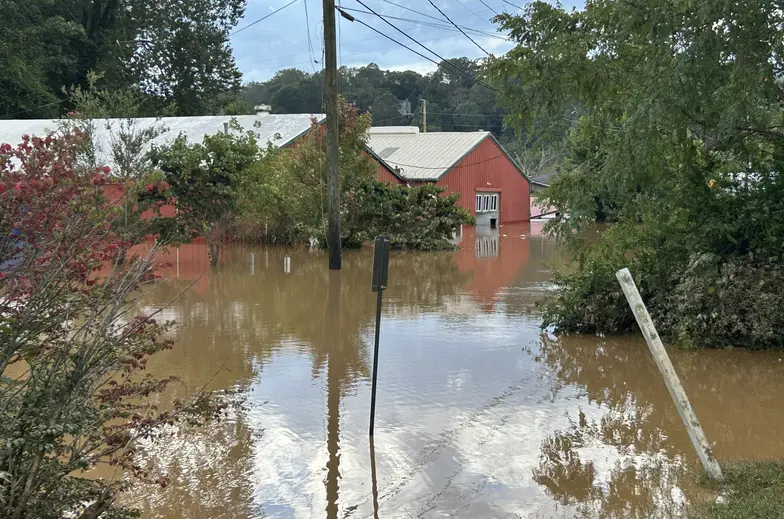
Flooding outside Brother Wolf’s former facility.
Hurricane Helene’s catastrophic September 2024 flooding devastated Western North Carolina and left Brother Wolf Animal Rescue — a beloved Asheville institution that cares for and rehomes companion animals such as dogs, cats and small animals — in ruins.
“Ours was a rented building that did a lot of good, but it wasn’t a very good building,” says Leah Craig Chumbley, Brother Wolf’s executive director, who has served the organization for 10+ years. “It was crumbling. It never had floor drains. It was a metal shell with concrete floors.”
The storm deposited sewage, sludge and 12 feet of contaminated water inside. Everything was lost.
For Leah Craig and the Brother Wolf team, Helene’s aftermath demanded immediate, decisive change, forcing them to reimagine how to continue serving a community with more needs, fewer resources and a future that had to be rebuilt from the ground up.
Emergency Evacuation
On September 26, 2024, a day ahead of the approaching storm and with 100 animals in their shelter, Brother Wolf issued a call for help through traditional and social media.
“Fifty animals were already in foster homes, but we needed to evacuate 100 more,” Leah Craig explains. “We issued our plea at 9 a.m. When I opened the door at 10 a.m., there was a line of people with carriers, leashes and blankets. We thought it would be hard, but we emptied our shelter in two hours! We never thought it could happen that fast.”
Evacuating a day ahead proved to be a life-saving decision. The storm wiped out kennels, work spaces, storage and the organization’s adjacent thrift store.
“Our community stepped up to be our shelter when ours was lost. We can do the work, but if we’re not creating and nurturing relationships, everything can fall apart. Good business starts with intentionally nurtured relationships.”
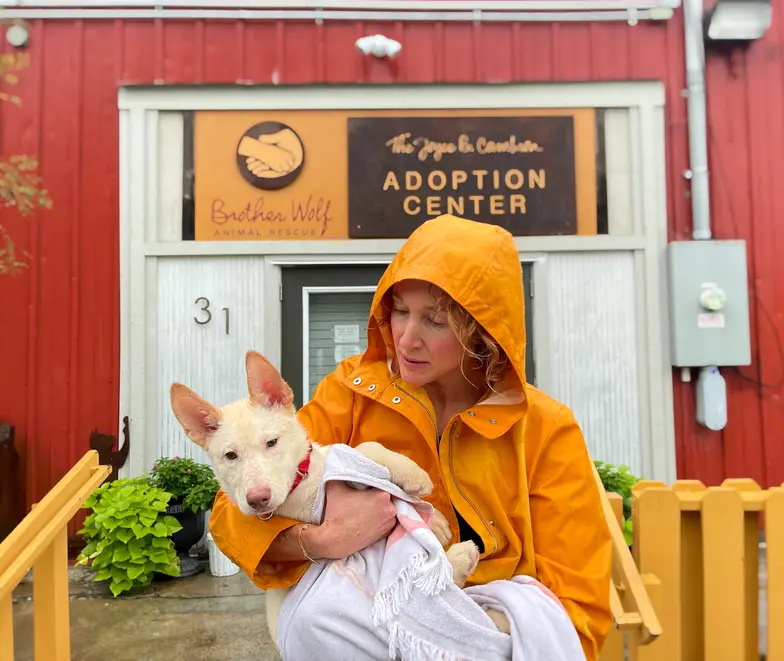
Brother Wolf’s executive director, Leah Craig Chumbley, evacuates a dog ahead of the storm.
Ensuring Continuity
With their animals safely in foster care, Brother Wolf pivoted to reestablishing operations at a temporary facility.
“Our immediate need was a destination that included workspaces for people to provide medical care, conduct intakes, facilitate adoptions and distribute supplies to foster caretakers,” says Leah Craig.
Help came from the ASPCA Spay/Neuter Alliance, with whom Brother Wolf has collaborated for many years.
On December 9, Brother Wolf began facilitating adoptions from the ASPCA Spay/Neuter Alliance twice a week — a reduction from their previous five-day model, but effective nonetheless.
Throughout the next year, Brother Wolf’s commitment to excellent customer service never wavered.
“Our community stepped up to be our shelter when ours was lost,” says Leah Craig. “We can do the work, but if we’re not creating and nurturing relationships, everything can fall apart. Good business starts with intentionally nurtured relationships.”
Before Helene, 70% of Brother Wolf’s population spent time in foster care; that number is now 100%.
Numbers Tell the Story
For 15 months, Brother Wolf operated without a facility and closely tracked their data, hoping it would help shape their future sheltering model.
Comparing pre- and post-storm intake numbers, Brother Wolf — despite lacking a facility — served 73% as many cats and 68% as many dogs, while small-animal intakes rose 81% and adoptions surged 169%.
“Our small animal program was always foster-based, with none living onsite, even when we had a facility,” says Brother Wolf’s Amy Duskiewicz, senior director of operations. “We strengthened our relationship with community members who support small animals, helping them care for an abandoned mother rabbit with a litter of 10, for example. We also collaborated with another small-animal rescue and began accepting small animals from our shelter partners, something we hadn’t done before.”
The overall number of animals who were adopted increased. While 86% of Brother Wolf’s intakes were adopted in 2023 and 85% in 2024, 93% of intakes (905 animals) were adopted in 2025.
“We only take in animals for whom we have a guaranteed foster home,” Leah Craig says. “We struggled with large-dog placements, whose intake numbers dropped, but other intakes didn't shift.”
With animals no longer on-site — except for adoption meetings or post-op care — volunteer opportunities shifted, and many stepped up to foster.
“The number of animals placed in foster care rose 166% over the previous two-year average, as did the number of foster homes, which rose 112%,” says Leah Craig.
“Our numbers helped paint a picture of what can be accomplished to help animals with little infrastructure,” she adds. “It also shows the impact of collaboration, as most of our animals came from under-resourced Western North Carolina shelters within a two-hour radius that would not have been able to serve those animals. Our collaboration with these shelters and the ASPCA was lifesaving.”
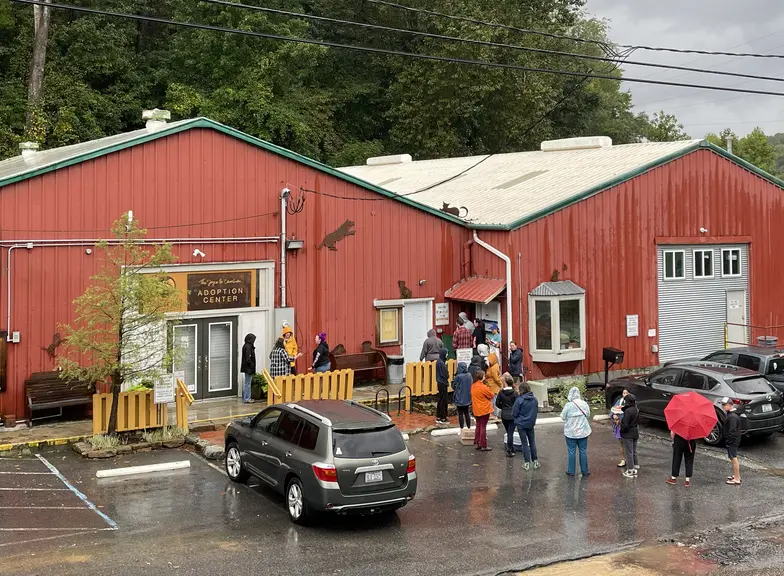
Prospective foster volunteers lined up outside Brother Wolf the day before the storm.
Looking Ahead
“It was inspiring to watch Brother Wolf move from a brick-and-mortar building with full shelter operations to a foster-based organization operating out of a small portion of our building,” says Eleanor Sprinkle, vice president of the ASPCA Spay/Neuter Alliance. “And during that time, they increased their capacity.”
Increased capacity now means Brother Wolf wants to offer more services to the community.
“We want to be a high-volume, mostly foster-based organization with a campus — a resource center — where people can adopt and get other services,” says Leah Craig.
In May 2026, Brother Wolf Animal Rescue announced the purchase of a building near downtown Asheville that will be renovated into an Adoption Center. Foster homes will continue to serve as the backbone of the organization, both throughout the rebuilding process and into the future. The Adoption Center will focus on housing animals for adoption, allowing Brother Wolf to maximize lifesaving while continuing to keep animals happy, healthy and supported in foster homes.
“We know shelters are not ideal places for animals,” Leah Craig says. “We work hard to give the best care, but a shelter is inherently stressful and loud. It’s not a home. Our goal isn’t to house as many animals as possible in one building,” she adds. “It’s to create a thoughtful Adoption Center that works alongside foster homes to give animals a calmer, healthier experience.”
Leah Craig considered zoning challenges, adequate housing for large dogs and willingness of landlords to rent space to shelters. She visited numerous shelters with these points in mind:
What to Consider When Rebuilding Your Shelter
- What can we build that will have the greatest impact?
- Can we make it a joyful and welcoming experience?
- How can our facilities help families learn more about the animals in our care?
- How do we build a campus that serves as a safety net for adoptable animals waiting in shelters and pets at risk of relinquishment?
- What does our community need to help care for their owned pets?
- How can we help people learn more about our animals and what they need to thrive?
Helping the Community
As if operating without a shelter and transitioning to 100% foster-based programs wasn’t enough, Brother Wolf boosted its services in 2024 after Helene, in partnership with other nonprofits, and provided free veterinary care to 1,272 pets whose families were devastated by the storm.
They also launched a pet-retention program, Stay Together, covering portions of veterinary bills to help struggling families keep their pets.
“The majority of the vet care stipends we're providing through this program are in three categories: spay/neuter, dental surgery and wellness care,” says Leah Craig. “These categories represent our community’s greatest pet-service needs and helped inform our decision to pursue opening a low-cost veterinary clinic as well.”
Fosters Make the Difference
While Brother Wolf’s use of the ASPCA’s facility has come to an end, one thing that hasn’t changed is their foster-based model, which is made possible by the collaborative relationships among animal welfare organizations in the area.
“While staff numbers dropped from 40 to 17 due to the loss of our shelter and thrift and retail stores, it’s amazing what we were able to accomplish,” Leah Craig says. “Our numbers reflect a successful foster program. With more foster caregivers, you inherently have more people talking about their involvement in your organization. They’re spreading your message. They’re your advocates.”
Brother Wolf’s average foster commitment is two weeks, and they also recruit fosters for short periods, such as weekends. The organization provides all necessary supplies and covers the veterinary costs associated with each foster animal.
“This town is incredible; it’s a very animal-friendly community,” Leah Craig says. “It’s not like, ‘This is Brother Wolf’s work alone’; we are all Brother Wolf. It felt like that before, during and after the storm.”
We have lots more on this subject: